
Introduction
The rapid growth of online education and digital assessments has changed how examinations are conducted in India. Universities, coaching institutes, schools, and certification providers increasingly rely on online exams to evaluate students at scale.
But one major challenge remains: How can an institution ensure that an online exam is fair, secure, and free from cheating?
This is where a remote proctoring platform comes in.
Remote proctoring uses technology to monitor candidates during online examinations and identify suspicious activities without requiring students to be physically present in an examination hall. From identity verification and webcam monitoring to browser security and AI-based detection, these platforms create a controlled digital examination environment.
What Is a Remote Proctoring Platform?
A remote proctoring platform is an online examination technology that allows institutions to supervise candidates remotely while they take an exam using a computer or other supported device.
Instead of having an invigilator physically present, the platform uses features such as:
Webcam and microphone monitoring
Candidate identity verification
Screen monitoring or recording
Secure browser technology
AI-based suspicious activity detection
Environment and device checks
Live or recorded proctoring
Automated examination reports
The goal is to maintain exam integrity while allowing candidates to take tests from their preferred location.
How Does Remote Proctoring Work in India?
Although the exact process differs between platforms, a typical remote proctored examination follows several stages.
1. Candidate Registration and Verification
Depending on the institution's requirements, they may need to verify their identity using an ID document, photograph, or facial verification.
2. System and Device Checks
The platform may check whether the candidate's device meets the technical requirements.
Common checks include:
Webcam and microphone availability
Internet connection
Browser compatibility
Operating system requirements
Camera permissions
Screen-sharing permissions
These checks help reduce technical problems once the exam begins.
3. Environment Verification
This can help identify unauthorized materials, additional people, or potentially suspicious objects near the candidate.
4. Secure Examination Environment
Security controls are then activated to reduce opportunities for cheating.
Depending on the platform, these may include:
Blocking unauthorized browser tabs
Preventing copy and paste
Restricting screen switching
Detecting prohibited applications
Controlling access to external resources
A secure browser can be particularly useful for high-stakes examinations because it creates a more controlled testing environment.
5. AI-Based Monitoring
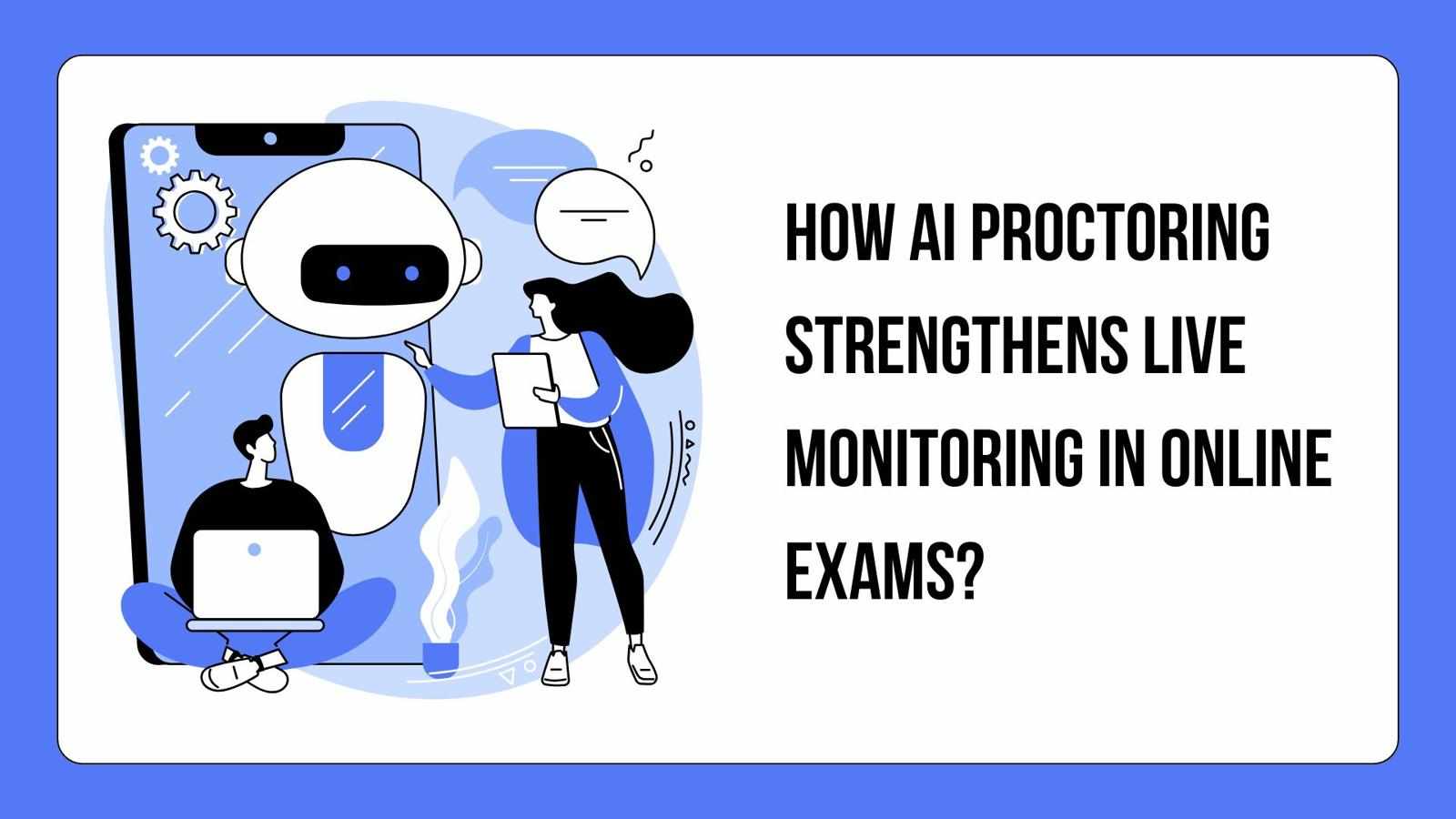
Modern remote proctoring platforms can use artificial intelligence and computer vision to identify potentially suspicious behavior.
For example, the system may flag:
Multiple faces appearing on camera
A candidate leaving the camera frame
Repeated unusual head movements
Suspicious use of another device
Unexpected sounds
Attempts to switch applications or tabs
Importantly, an AI-generated flag does not necessarily mean that cheating occurred. Institutions should review flagged events and apply appropriate examination policies before making a final decision.
6. Live or Recorded Proctoring
Remote exams can be supervised in different ways.
Live proctoring: A human invigilator monitors candidates in real time and can intervene when necessary.
Recorded proctoring: The examination session is recorded and reviewed later, either manually or with automated assistance.
AI-assisted proctoring: Artificial intelligence continuously analyzes the examination session and generates alerts or reports for review.
Many institutions combine automated monitoring with human review to improve both scalability and decision-making.
7. Examination Reports
After the examination, the platform can generate reports containing information such as candidate activity, flagged incidents, verification results, and examination status.
These reports help administrators review exam sessions and maintain an auditable record of the assessment.
Why Is Remote Proctoring Important for Indian Institutions?
India has a large and geographically distributed student population. Conducting physical examinations for thousands or millions of candidates can require significant infrastructure, staffing, travel, and administrative resources.
Can help institutions:
Scale examinations: Conduct assessments for candidates across different cities and regions.
Reduce logistical requirements: Minimize dependence on physical examination centers.
Improve exam security: Combine identity verification, monitoring, and browser restrictions.
Support flexible testing: Allow eligible candidates to take examinations remotely.
Create digital records: Maintain examination logs and monitoring reports for review.
Key Features to Look for in Remote Proctoring
Institutions evaluating remote proctoring should consider more than just webcam monitoring.
Important features include:
AI-powered monitoring
Live human proctoring
Secure browser capabilities
Identity verification
Webcam and microphone monitoring
Screen monitoring
Automated incident reporting
Scalable cloud infrastructure
Candidate-friendly interface
Strong data security and privacy controls
For Indian institutions, support for different network conditions, device compatibility, and large-scale examinations can also be important considerations.
Remote Proctoring vs Traditional Exam Invigilation
Traditional examinations depend heavily on physical examination centers and human invigilators. Remote proctoring shifts much of this process into a digital environment.
While traditional invigilation provides direct physical supervision, remote proctoring offers greater flexibility and scalability. However, technology should not completely replace human judgment, particularly when automated systems flag unusual candidate behavior.
A strong examination strategy combines technology, clear policies, human review, and appropriate security measures.
The Future of Online Exams in India
As digital education and assessment continue to expand, remote proctoring is likely to remain an important part of India's examination ecosystem.
The next generation of platforms will increasingly focus on AI-assisted security, better identity verification, stronger browser controls, improved accessibility, and more transparent examination analytics.
The objective should not simply be to monitor candidates more aggressively. Instead, the focus should be on creating an examination environment that is secure, fair, accessible, and reliable.
FAQs
What is remote proctoring in online exams?
Remote proctoring is technology that allows institutions to monitor candidates during online examinations using tools such as webcams, microphones, screen monitoring, identity verification, and AI-based analysis.
Is remote proctoring safe?
Remote proctoring can be secure when the platform uses appropriate data protection, access controls, encryption, transparent policies, and responsible data-retention practices.
Can remote proctoring detect cheating?
Remote proctoring can identify and flag potentially suspicious activities, such as multiple faces, prohibited applications, unusual movements, or attempts to leave the examination environment. Human review may be required before determining whether a rule violation actually occurred.
Do I need a webcam for a remote proctored exam?
Many remote proctored examinations require a webcam for identity verification and monitoring, although requirements vary by institution and platform.
Conclusion
Remote proctoring platforms are transforming how online examinations are conducted in India. By combining identity verification, AI-based monitoring, secure browser technology, human oversight, and examination analytics, institutions can create a more controlled digital testing environment.
However, successful remote examination is not just about surveillance. Institutions must also prioritize fairness, accessibility, candidate experience, privacy, and transparent examination policies.
As India's education ecosystem continues to embrace digital assessments, remote proctoring can play a significant role in making online examinations more scalable, secure, and dependable.






Write a comment ...